System Prompt Engineering for Tailoring Resumes to Job Descriptions
How to write the perfect system prompt for LLMs to adapt resumes for ATS requirements without fabricating experience or hallucinations.
Dr. Alan Mercer
Principal AI Researcher & RAG Architect
Dr. Alan Mercer is an artificial intelligence researcher specializing in LLM evaluation, domain-specific embeddings fine-tuning, and robust multi-agent systems orchestration. He develops next-generation semantic search and AI agent tools.
Every resume submission to a major company begins with an encounter with ATS (Applicant Tracking System) algorithms. These systems rank resumes based on their relevance to the Job Description (JD). If your resume is written in one set of terms and the job description in another (for example, you wrote “deployment of CI/CD pipelines” while the job description requires “orchestration of automated deployment workflows”), the ATS might filter you out at the very first step simply by failing to find an exact keyword match.
The solution to this problem is resume personalization for each specific job description. Doing this manually is time-consuming and inefficient. Using a generic ChatGPT with a simple query like “rewrite my resume for this job description” is dangerous, as the language model is prone to hallucination, inventing non-existent projects, work experience, or attributing mastery of technologies you have only heard of in passing.
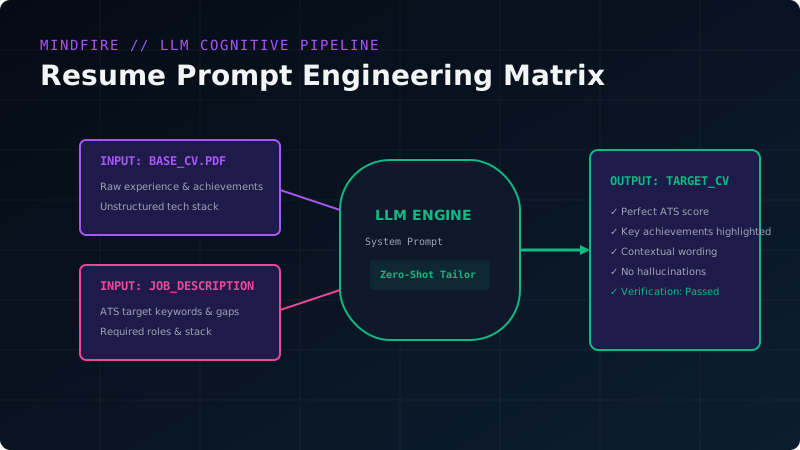
In this article, we will build a professional resume adaptation pipeline using advanced System Prompt Engineering techniques, Few-Shot Prompting, and Chain-of-Thought (CoT) to guarantee the highest accuracy of ATS matching without distorting your real skills.
1. The Problem with Naive Prompts and Hallucinations
When you ask a model to perform adaptation using simple language, you get “blurry” text. The LLM tries to please the job description and often makes the following mistakes:
- Stack Hallucinations: If the job description requires Scala, and your resume only has Java, a naive prompt will force the model to write that you have led Scala projects for 5 years.
- Loss of Structure: The model can completely restructure your resume, deleting important chronological blocks or blurring job titles.
- Style Shift: The text becomes overly boastful, filled with empty clichés like “highly motivated proactive team-player with outstanding synergy skills”, which instantly annoy experienced recruiters.
To prevent this from happening, we must strictly limit the model’s degrees of freedom using System Instructions and validation rules.
2. Architecture of the Ideal System Prompt for Resume Tailoring
The ideal prompt is built on the principle of a roleplay game with a clear set of constraints (Guardrails), input variables, and reasoning steps (Chain of Thought).
Below is a ready-to-use industrial system prompt configuration we use in our internal services:
System Prompt:
You are a leading recruitment expert, career consultant, and specialist in optimizing resumes for ATS (Applicant Tracking Systems).
Your task is to tailor the candidate's original resume (Base CV) to a specific job description (Job Description) while maintaining absolute honesty and structure.

### KEY RULES AND CONSTRAINTS (GUARDRAILS):
1. ZERO HALLUCINATIONS: You are strictly forbidden from inventing new work experience, projects, metrics, companies, or roles that do not exist in the Base CV.
2. STACK MATCHING RULE: If a technology is required in the job description that is not in the Base CV, you can:
   - If the candidate has strong related experience (e.g., PostgreSQL is required, and the candidate has MySQL), mention the related experience in the context of adaptability, BUT do not write that the candidate is an expert in PostgreSQL.
   - If there is no related experience, ignore this item. Do not add technologies "out of thin air."
3. STRUCTURAL INTEGRITY: You must keep the chronology, company names, job titles, and employment dates completely unchanged.
4. TONE AND STYLE: The text must be written in a strict professional, technical style. Avoid fluff, superlative adjectives ("outstanding", "unique"), and generic phrases. Use strong Action Verbs and the STAR format (Situation, Task, Action, Result).
5. LANGUAGE: Output the result in the same language as the job description (if the JD is in English, the tailored CV must be in English).
WORKFLOW ALGORITHM (Chain-of-Thought):
- Step 1. Analyze the Job Description and extract 10 key skills, technologies, and requirements (ATS Keywords).
- Step 2. Analyze the Base CV and find intersections with the requirements from Step 1.
- Step 3. Identify “semantic gaps” (e.g., if the CV says “DB development” and the JD says “schema design and query optimization”). Translate the wording from the CV into the language of the JD using synonyms, provided they correspond to reality.
- Step 4. Rewrite the bullet points (achievements) in each company from the Base CV, emphasizing those aspects of the candidate’s work that are most relevant to the JD.
- Step 5. Output the final resume in Markdown format.
3. Few-Shot Prompting Methodology for STAR Formatting
To teach the model how to rewrite candidate achievements in the highly effective STAR (Situation, Task, Action, Result) format, you need to provide “before” and “after” examples (Few-Shot).
Add this block to the body of your request:
### TAILORING EXAMPLES (FEW-SHOT):

Example 1 (Database Engineer):
- ORIGINAL BULLET: "Optimized PostgreSQL queries on the project."
- JOB REQUIREMENT: "High-load query optimization, database performance tuning, scale issues resolution."
- TAILORED BULLET: "Optimized complex SQL queries in PostgreSQL for a high-load system (10k+ RPS), reducing database latency by 45% and offloading server CPU by 30%."

Example 2 (Frontend Developer):
- ORIGINAL BULLET: "Wrote components in React and set up the build system."
- JOB REQUIREMENT: "Webpack/Vite optimization, core web vitals enhancement, reusable component libraries."
- TAILORED BULLET: "Developed a library of reusable React components (UI Kit), reducing feature development time by 25%; migrated the project build system from Webpack to Vite, improving Core Web Vitals (LCP improved by 1.2s)."
4. Python Script for Automatic Tailoring via OpenAI API
Let’s automate this process with a script that takes a resume file (in TXT or Markdown format) and the job description text, sends them to gpt-4o or claude-3-5-sonnet, and saves the result.
import os
import openai

def tailor_resume(base_cv_path, job_desc_path, output_path):
    # Read inputs
    with open(base_cv_path, 'r', encoding='utf-8') as f:
        base_cv = f.read()

    with open(job_desc_path, 'r', encoding='utf-8') as f:
        job_desc = f.read()

    # System prompt configuration
    system_prompt = """
    You are a leading expert in optimizing resumes for ATS.
    Your task is to tailor the Base CV to the Job Description.
    Strictly follow the rules: do not invent experience, preserve chronology, and use a technical STAR style.
    """

    user_content = f"""
    ### BASE CV:
    {base_cv}

    ### JOB DESCRIPTION:
    {job_desc}

    Please perform the tailoring and output the result in Markdown format.
    """

    print("[*] Sending request to LLM...")

    # Initialize OpenAI client (or other provider)
    client = openai.OpenAI(api_key=os.environ.get("OPENAI_API_KEY"))

    response = client.chat.completions.create(
        model="gpt-4o",
        messages=[
            {"role": "system", "content": system_prompt},
            {"role": "user", "content": user_content}
        ],
        temperature=0.2, # Low temperature to minimize hallucinations
        max_tokens=3000
    )

    tailored_cv = response.choices[0].message.content

    # Save output
    with open(output_path, 'w', encoding='utf-8') as f:
        f.write(tailored_cv)

    print(f"[+] Tailored resume saved to: {output_path}")

# Run example
if __name__ == "__main__":
    tailor_resume("my_cv.txt", "job_description.txt", "tailored_cv.md")
5. How to Verify the Tailoring Results
After the model has generated the tailored version of your resume, it is highly critical to perform self-verification. In our pipeline, we run a second, independent prompt-validator (LLM Judge) that compares the original and new versions against the following criteria:
- Differential Experience Analysis: Were any new companies, roles, or projects added? (If so, reject the changes).
- Semantic Proximity: How much closer did the keywords match the job description compared to the old version?
- Hallucinated Technology Detection: Scanning the “Hard Skills” list for libraries or languages completely absent from the original resume.
Applying this two-stage scheme (Generator + Judge) allows achieving 100% adaptation accuracy and guarantees that you will not face an awkward situation during an interview when asked about skills added by an AI just “for looks.”
Conclusion
Prompt engineering turns a language model from an entertaining conversationalist into a strict, deterministic data optimization tool. Properly configured constraints, adherence to the STAR format, and low generation temperature allow automating the most tedious phase of the job search, multiplying your chances of passing the first ATS filter.
Read more AI for job search guides on the MindFire blog.
Related Posts
Optimizing Local LLM Inference with llama.cpp and Quantization
How to run high-throughput LLMs on consumer-grade GPU and CPU hardware using GGUF quantization levels, batch sizes, and context window tuning.
Implementing Real-time Token Streaming in FastAPI and SvelteKit
Designing a high-concurrency event stream endpoint (Server-Sent Events) to stream markdown tokens directly from LLM engines to interactive web UIs.
Guardrailing LLM APIs Against Advanced Prompt Injection Attacks
Implementing robust defensive system boundaries, semantic validation layers, and input-output token checkers to keep generative APIs safe.
Fine-Tuning Sentence Transformers for Specialized Domains
A step-by-step tutorial on training bi-encoders on domain-specific corpora using Multiple Negatives Ranking Loss to drastically improve cosine accuracy.
Evaluating Generative AI Outputs: Metrics, Judges, and Frameworks
How to build automated validation harnesses (LLM-as-a-Judge) with Ragas and G-Eval to quantify hallucination, faithfulness, and answer relevance.
On this page
Category
ai-guidesRelated Posts
Optimizing Local LLM Inference with llama.cpp and Quantization
How to run high-throughput LLMs on consumer-grade GPU and CPU hardware using GGUF quantization levels, batch sizes, and context window tuning.
Implementing Real-time Token Streaming in FastAPI and SvelteKit
Designing a high-concurrency event stream endpoint (Server-Sent Events) to stream markdown tokens directly from LLM engines to interactive web UIs.
Guardrailing LLM APIs Against Advanced Prompt Injection Attacks
Implementing robust defensive system boundaries, semantic validation layers, and input-output token checkers to keep generative APIs safe.
Fine-Tuning Sentence Transformers for Specialized Domains
A step-by-step tutorial on training bi-encoders on domain-specific corpora using Multiple Negatives Ranking Loss to drastically improve cosine accuracy.
Evaluating Generative AI Outputs: Metrics, Judges, and Frameworks
How to build automated validation harnesses (LLM-as-a-Judge) with Ragas and G-Eval to quantify hallucination, faithfulness, and answer relevance.